The harbour that became
Ponyo
— and the bus you have to take.
Tomonoura is a small working port on the Inland Sea where Hayao Miyazaki stayed while he was thinking about Ponyo. It has a stone lantern on the quay, a temple hall with one of the great sea views in Japan, and almost no coach traffic. The catch is the transfer.
Go if you want an old harbour with no coach park and you do not mind a two-leg journey: shinkansen to Fukuyama, roughly 25 minutes, then a bus of roughly 30 minutes to the port. That is 4–7 hours door to door depending on how long you stay. Skip it if your day trip has to be simple — Iwakuni is one train and one bus for a comparable half day. The bus fare and the shinkansen fare are unverified.
What Tomonoura is
Answer firstA functioning fishing harbour of about 4,000 people that kept its Edo-period shape, on a headland where the Inland Sea's tides meet.
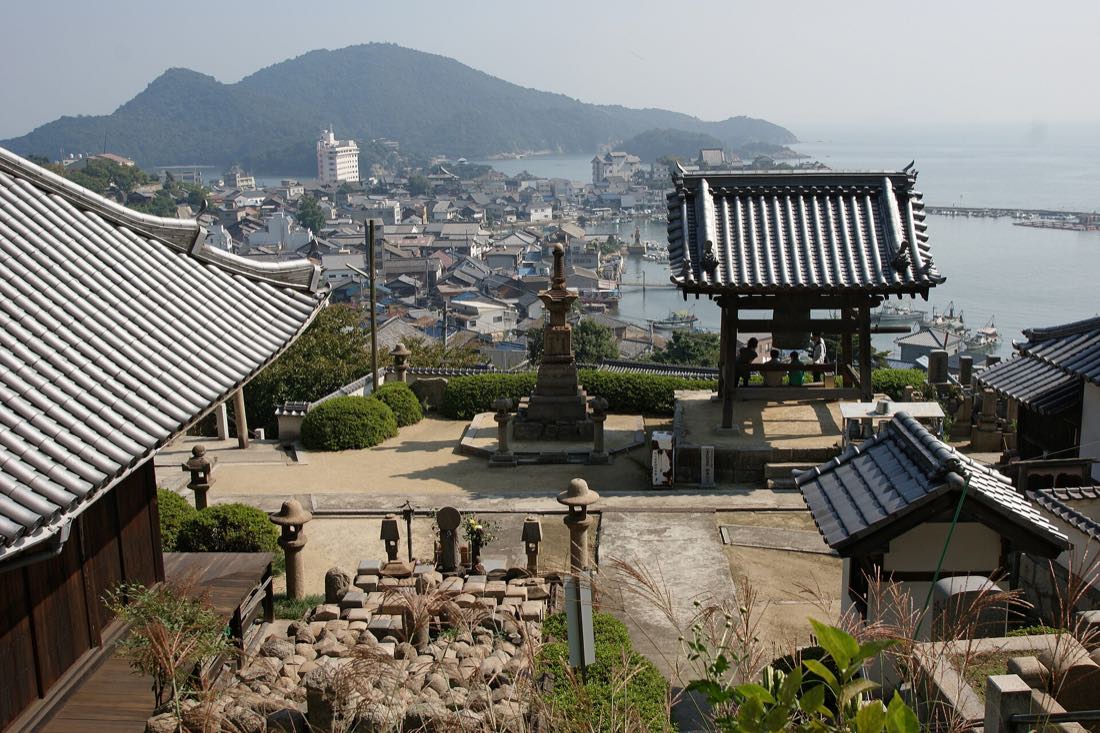
The reason boats stopped here for centuries is tidal: currents from either end of the Inland Sea converge off this point, so sailing ships waited here for the turn. That is why a small place has a formal stone-lantern lighthouse on the quay, a harbour wall with mooring steps, warehouses, and temples sited to look out over the water rather than inland.
The Ponyo connection is widely cited rather than something we can source to the studio, and we are going to be careful about it: what is reported is that Hayao Miyazaki stayed here in 2005, and the harbour's shape — the seawall, the slipway, the hillside houses — is recognisable in the film. What you will certainly not find is a Ghibli attraction. There is no museum, no character trail and no ticket. If that is what someone in your party is expecting, say so before you buy the tickets.
The things actually worth your time are the quay itself, Taichōrō — the reception hall at Fukuzen-ji whose open frontage frames the islands offshore — the hillside temple Iō-ji, the narrow lanes behind the harbour, and the five-minute ferry to the small island opposite. The town is also the home of homeishu, a herbal medicinal liqueur made here for centuries. We could not confirm the admission fees for Taichōrō or Iō-ji — the Fukuyama tourism site refused connections repeatedly. Both charge small admissions in the low hundreds of yen; check on arrival and carry coins.
The honest limitation is scale. You can walk the whole town in 90 minutes. With the temple, the island ferry and lunch it becomes 3 to 4 hours, which is a good afternoon and not a full day — and the journey either side is what pushes it to 4–7 hours in total. Hiroshima oysters are a winter dish — roughly October to March, peaking December to February. Come in July and you'll find the farmed summer Kaki Komachi variety and a lot of restaurants simply not doing oysters. The grilled-oyster stalls and the festivals are a November-to-March thing.
Tomonoura, practically
Plan your visitWhat to actually do in Tomonoura
Ranked- 01
The stone lantern and the harbour wall
A 19th-century stone lantern lighthouse standing on the quay above the mooring steps, with the harbour working around it. This is the image of the town and the one thing you would come back for. Best in low sun, early or late, when the light comes off the water.
- 02
Taichōrō, the hall at Fukuzen-ji
A reception hall with its front open to the sea, framing the islands offshore. It has been called one of the finest views in the country by people with more authority than us, and the point is that you sit on the matting and look at it rather than walk past it. The admission is a small one in the low hundreds of yen — we could not confirm the exact figure, so carry coins.
- 03
The lanes behind the harbour
Warehouses, a working boatyard, houses that never got rebuilt and the odd shop selling homeishu. The town is small enough that getting lost is a 10-minute problem, which is exactly the right size for wandering without a plan.
- 04
The ferry to the island opposite
Worth it if you have the whole afternoon and want a beach and a hill walk; not worth it if you are watching the bus back to Fukuyama. The crossing itself is short and the view back at the harbour is the best argument for going.
- 05
Looking for Ponyo
Miyazaki is reported to have stayed here in 2005 and the town's shape is recognisable from the film, but the connection is widely cited rather than something we can source to the studio — and there is no Ghibli museum, trail or ticket here. It works as a quiet recognition and fails as a themed outing. Set expectations before you travel, particularly with children.
Tomonoura against the other small-town trips
ComparedAll three are old towns on the Inland Sea within about 90 minutes of Hiroshima. They are not interchangeable.
| Tomonoura | Onomichi | Iwakuni | |
|---|---|---|---|
| Journey | Shinkansen ~25 min + bus ~30 min | Local line ~1h30 | Local line ~50 min + bus |
| Time needed | 4–7 hours | Full day | 4–6 hours |
| Terrain | Flat harbour town | Steep — stone stairs throughout | Flat, plus a ropeway |
| The single object | The lantern quay | The temple walk down the hill | The five-arch bridge |
| Crowds | Lowest of the three | Moderate, rising | Highest at blossom and autumn |
| Rain | Poor — it is all outdoors | Bad — wet stone stairs | Poor |
| Fares | Unverified | Unverified | Unverified |
| Verdict | DEPENDS | WORTH IT | WORTH IT |
Tomonoura's DEPENDS is entirely about the two-leg transfer and about scale — it is the smallest of the three and the one most easily exhausted in an afternoon. If you like small working harbours more than you like sights, it is the best of them. Journey times in this section are indicative rail-line estimates, not timetable readings, and fares are left blank on purpose: we could not verify a single day-trip fare against JR West's published table on 4 August 2026. A page that tells you a fare is unverified is more use than a page that guesses it.
Guided Tomonoura
Booking and getting thereThis is the trip where guiding solves a genuine problem: the Fukuyama bus leg is the part people get wrong, and nothing in the town is labelled in English. We do not publish tour prices, ratings or review counts because we have not verified them; open a link for live pricing.
Tomonoura — the questions people actually ask
FAQPage schema pairedHow do I get to Tomonoura from Hiroshima?
Sanyo shinkansen to Fukuyama, roughly 25 minutes, then a local bus of about 30 minutes from outside Fukuyama Station to the port — the bus leg is the one confirmed figure on this trip. Both fares are unverified: check the shinkansen fare with JR West and the bus fare at the stand. Door to door the trip runs 4–7 hours depending on how long you stay.
Is Tomonoura really the town from Ponyo?
It is widely cited as the inspiration and we cannot source it to the studio, so we will not state it as fact. What is reported is that Hayao Miyazaki stayed here in 2005, and the harbour's shape is recognisable in the film. There is no Ghibli museum, trail or ticket here and nothing is officially themed. Treat it as a quiet recognition rather than an attraction, especially with children.
How long do you need in Tomonoura?
90 minutes to walk the whole town, 3–4 hours to do it properly with the temple hall, the lanes and lunch, and up to a full afternoon if you take the 5-minute ferry to the island opposite. It is small; the journey is what makes it a half to full day rather than the town.
What does it cost to visit Tomonoura?
Tomonoura is the least verified trip in this section and you should know that before you go. The shinkansen fare, the bus fare, the merchant house and the island ferry are all unconfirmed as of 4 August 2026, and the Fukuyama tourism site refused connections repeatedly when we tried to check the temple admissions. What we can say: the bus is about 30 minutes, the temples charge small admissions in the low hundreds of yen, and the shinkansen leg is covered by rail passes on non-Nozomi services — see the pass comparison.
Is Tomonoura better than Onomichi?
Different, and smaller. Onomichi is a full day of steep stone stairs, 25 temples and a ropeway; Tomonoura is a flat harbour you can cross in 15 minutes and a temple view you sit down in front of. If you have one day, take Onomichi. If you have three day trips or you actively dislike crowds, take Tomonoura.
Can I do Tomonoura and Kure in one day?
Independently, it is a stretch — they are on opposite sides of Hiroshima and both need bus or walking legs at the far end. There is a guided day that combines them, which is the practical answer. Doing it yourself means about 3 hours of travel for roughly 5 hours on the ground across two towns.
Is Tomonoura good in the rain?
No. The lantern quay, the lanes and the sea views are the town, and all three are outdoors — and you would be spending 4–7 hours door to door to walk around in it. On a wet day take Kure, where both museums are indoors. Tsuyu, the rainy season, normally runs 6 June to 19 July, and July is the wettest month of the year at 279.8mm.
Is there anything to eat in Tomonoura?
Small harbour restaurants doing what the boats bring in, plus the local herbal liqueur, homeishu. Prices are unverified and the range is narrow — this is a town of about 4,000 people, not a food destination. Between October and March you are on the right coast for oysters; see the oyster page for the season.