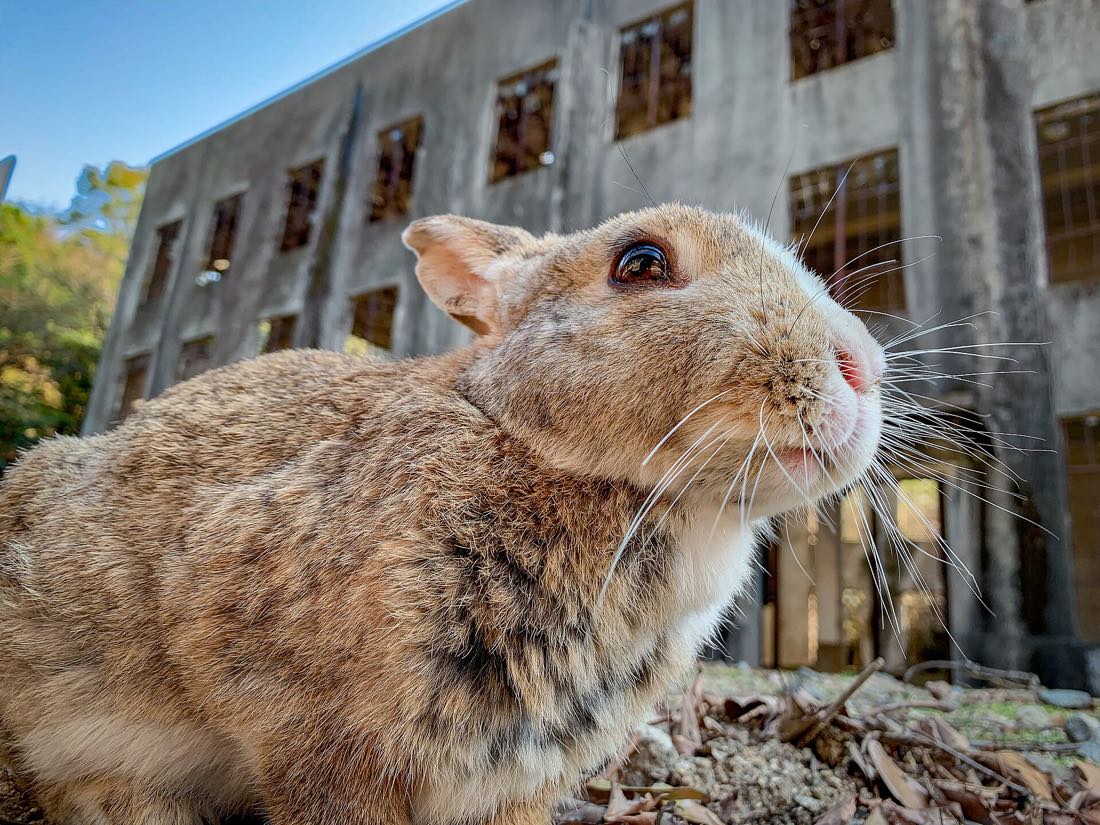
Rabbit Island
was a poison gas plant.
Both things are true.
Several hundred feral rabbits live on a small island in the Inland Sea that the Japanese Army used to manufacture chemical weapons, and which was removed from some maps while it did. You can have a good day here. You should not have it without walking through the museum.
Go if you have a whole day free — rail to Tadanoumi is roughly 1h20, then a short ferry — and if you are prepared to spend 30 minutes in the poison gas museum before you spend two hours with the rabbits. Do not go on a half day, and do not go expecting a petting zoo: these are feral animals on an island with weapons-plant ruins on it. The rail fare, the ferry fare, the museum admission and the current rules about feeding are all unverified.
What the island is, in the right order
Answer firstA former Imperial Japanese Army chemical weapons facility, roughly 4km around, now covered in feral rabbits and visited mostly by people who only know about the second half.
From the late 1920s the army manufactured poison gas on Okunoshima, in secret, and the island was reportedly removed from some published maps for the duration. Workers were exposed; the after-effects lasted decades. The Okunoshima Poison Gas Museum, a small municipal museum on the island, documents the plant, the labour and the health consequences, and the concrete ruins of the power plant and storage batteries are still standing among the trees. The museum admission is not verified — it is small, and it is the reason to arrive with coins.
The rabbits are a later and separate story. Several hundred live wild across the island — counts reported publicly vary widely and we have verified none of them — and they approach visitors because visitors bring food. They are not tame, they are not owned, and there is no vet on site. This is the same dynamic that Miyajima's deer illustrate from the other direction: an animal population shaped entirely by what tourists do.
So the honest structure of a day here is: ferry, museum, then rabbits, then the walk around the shoreline and the ruins. Doing it in that order takes nothing away from the rabbits and stops the island being a place where you photographed something cute on top of something that killed people.
Practically, this is a full-day trip. The JR Kure line to Tadanoumi is roughly 1h20, the port is a few minutes' walk from the station, and the crossing is short. Ferries do not run continuously — missing one costs you real time, and the last departure back is the number that structures the whole day. We could not verify the timetable, the ferry fare or the rail fare. Check both at Tadanoumi before you cross, and photograph the return timetable on the pier.
Okunoshima, practically
Plan your visitThe rules, and which of them we could verify
On the islandEvery rule below is reported rather than verified. We are printing them because they are consistent across sources and because the failure modes are obvious, not because we have confirmed them with the island's operator. Read the signs at the pier — they are the authority.
Rabbit pellets are widely reported not to be on sale on the island itself. Buy before you cross at Tadanoumi. Unverified — but the downside of carrying pellets you did not need is nil, and the downside of the reverse is a day of apologising to rabbits.
Reported, not verifiedCabbage, lettuce and other wet greens are reported to cause serious digestive problems in these animals. Bring proper rabbit pellets. This is the rule most commonly broken by visitors carrying a supermarket bag.
Reported, not verifiedThey are feral animals with no veterinary care on site. Sit down, hold your hand out low, and let them come to you. Children under about 6 need a hand on the shoulder for this — the rabbits will run under feet and into road edges.
Common sense, universally postedVehicles use the island's roads. Feeding on tarmac trains the rabbits to gather where they are most likely to be hit, which is the single most damaging thing a well-meaning visitor does here.
Reported, not verifiedNot a rule — an editorial instruction. Thirty minutes in the Poison Gas Museum before you open the food bag changes what the afternoon is. Doing it in the other order almost never happens, because nobody walks away from an island full of rabbits to go and read about chemical weapons.
Admission unverified — carry coinsThe single practical failure on this trip is missing the return sailing on an island with one hotel on it. Timetables unverified — photograph the board at the pier when you arrive and set an alarm for 45 minutes before it.
Unverified — check on the dayWhat is actually on the island
ComparedFour things, and most visitors do one of them. The full day is all four.
| What | Time | Cost | Verdict |
|---|---|---|---|
| The rabbits | 1.5–2 hours | Price of a bag of pellets — unverified | WORTH IT |
| Poison Gas Museum | 30 minutes | Small admission — unverified | WORTH IT |
| The plant ruins and the shoreline loop | 1–1.5 hours | Free | WORTH IT |
| The observation point at the island's high ground | 40 minutes | Free | DEPENDS |
| Doing the island as a half day | — | — | SKIP |
The DEPENDS on the high ground: worth the climb on a clear day for the Inland Sea view, not worth it in August heat or if you are watching the last ferry. The SKIP is structural — the rail and ferry legs are roughly 1h20 plus a crossing each way, so a half day gives you about 90 minutes on the ground and no museum. Journey times in this section are indicative rail-line estimates, not timetable readings, and fares are left blank on purpose: we could not verify a single day-trip fare against JR West's published table on 4 August 2026. A page that tells you a fare is unverified is more use than a page that guesses it.
Guided, if the transfers put you off
Booking and getting thereThis is the transfer-heaviest trip in the section — train, walk, ferry, and a return sailing you cannot miss — which is exactly the case where a guided version earns its money. We do not publish tour prices, ratings or review counts because we have not verified them; open the link for live pricing.
Rabbit Island — the questions people actually ask
FAQPage schema pairedHow do I get to Rabbit Island from Hiroshima?
JR Kure line to Tadanoumi, roughly 1h20 from Hiroshima Station, then a few minutes on foot to Tadanoumi Port and a ferry of about 12–15 minutes. Both fares are unverified. Sailings are spaced rather than continuous, so photograph the return timetable at the pier before you cross.
How much does the ferry to Okunoshima cost?
Not verified, and we will not guess. Buy at the Tadanoumi terminal. While you are there, check the last return sailing — that number structures the whole day, and missing it strands you on an island with a single hotel on it. Budget on the basis that this is a full-day trip, 7–9 hours door to door.
Can I buy rabbit food on the island?
Reported as no — food is widely said not to be sold on Okunoshima itself, so you buy at Tadanoumi before you cross. We could not verify this rule, and the sensible response is to carry pellets anyway: the cost of unnecessary pellets is a few hundred yen against a 7–9 hour day, and the cost of arriving empty-handed is the whole reason you came.
What should I feed the rabbits?
Rabbit pellets. Not cabbage or lettuce — wet greens are widely reported to cause serious digestive problems in these animals, and this is the rule most often broken by visitors with a supermarket bag. Feed sitting down, off the roads, and let them come to you; 1 bag covers the 1.5–2 hours most people spend with them. Rules are reported, not verified; the signs at the pier are the authority.
How many rabbits are on Okunoshima?
Several hundred. Published counts vary widely — figures from a few hundred to around 1,000 circulate — and we have verified none of them, so we are not printing one as fact. What matters practically is that there are enough that you will be surrounded within 5 minutes of opening a bag anywhere on the island's 4km shoreline loop.
Why was Okunoshima a poison gas island?
From the late 1920s the Imperial Japanese Army manufactured chemical weapons here, in secret, and the island was reportedly taken off some published maps while it operated. Workers were exposed and suffered long-term health consequences. The Poison Gas Museum on the island covers it in about 30 minutes; admission is unverified, so carry coins.
Is Rabbit Island suitable for children?
Yes for the rabbits, from about age 4, with the caveat that these are feral animals that run underfoot and near roads. The museum is a harder call and mirrors the one families make at the Peace Park — you can walk the island without going in. Allow a full day and remember there is no half-day version. See Hiroshima with kids.
Can I combine Rabbit Island with Kure in one day?
Not comfortably. Both are on the JR Kure line, but Okunoshima needs its own full day — 1h20 of rail plus a ferry each way — and Kure's two museums want 3–4 hours on their own. Doing both means rushing the museum you travelled furthest for. Take two days, or take one and choose.