The bridge is ¥310
until 31 August.
On 1 September it is ¥500.
Iwakuni City is raising the Kintai Bridge crossing fee by 61% on 1 September 2026, and the bridge-ropeway-castle set ticket goes to ¥1,550. That is four weeks from now, no English page carries it, and it changes what this afternoon costs. Here is the old price, the new price, and the free way across at night.
Go, and if your dates allow it go before 31 August 2026: the bridge crossing is ¥310 ($1.97) now and ¥500 ($3.17) from 1 September, a 61% rise, with the elementary fare going ¥150 → ¥250. The set ticket covering the bridge, the ropeway and Iwakuni Castle goes to ¥1,550 adult ($9.83) and ¥700 child. Allow 1.5–2 hours on site, 4–6 hours door to door from Hiroshima. Buy the set ticket up front — you cannot upgrade a bridge-only ticket afterwards.
The price rise, first, because it is four weeks away
Answer firstOn 1 September 2026 the Kintai Bridge crossing fee goes from ¥310 to ¥500 for adults and from ¥150 to ¥250 for elementary-age children, and the set ticket that bundles the bridge, the ropeway and the castle goes to ¥1,550 adult and ¥700 child.
This is verified from Iwakuni City's own announcement. The stated reason is the cost of preserving a nationally designated scenic structure, which is a bridge rebuilt in traditional joinery on a cycle no other crossing in Japan has to fund. The adult bridge fare is rising 61%. The set ticket's increase is larger again, but we would hedge the exact percentage you will see quoted: the city's own comparison table sets ¥1,550 against ¥760, and ¥760 is the group rate, not the individual one, which was ¥970. Against ¥970, the individual set ticket rises by about 60%.
Two practical consequences. First, if your dates fall before 31 August, cross this month. Second, you cannot upgrade a bridge-only ticket to the set ticket after buying it — decide at the kiosk whether you are going up the hill, because changing your mind costs you the bridge fare twice.
The thing nobody publishes: the bridge itself is crossable 24 hours. The ticket office runs 8:00–17:00, extending to 18:00 in peak seasons and 19:00 in summer, but outside those hours the crossing operates on an honesty box — 「24時間入橋」. The lights on the bridge go off after 22:00. That means a 06:30 crossing with nobody on it, or a walk over the arches under a night sky, is available to anyone prepared to put the fare in the box.
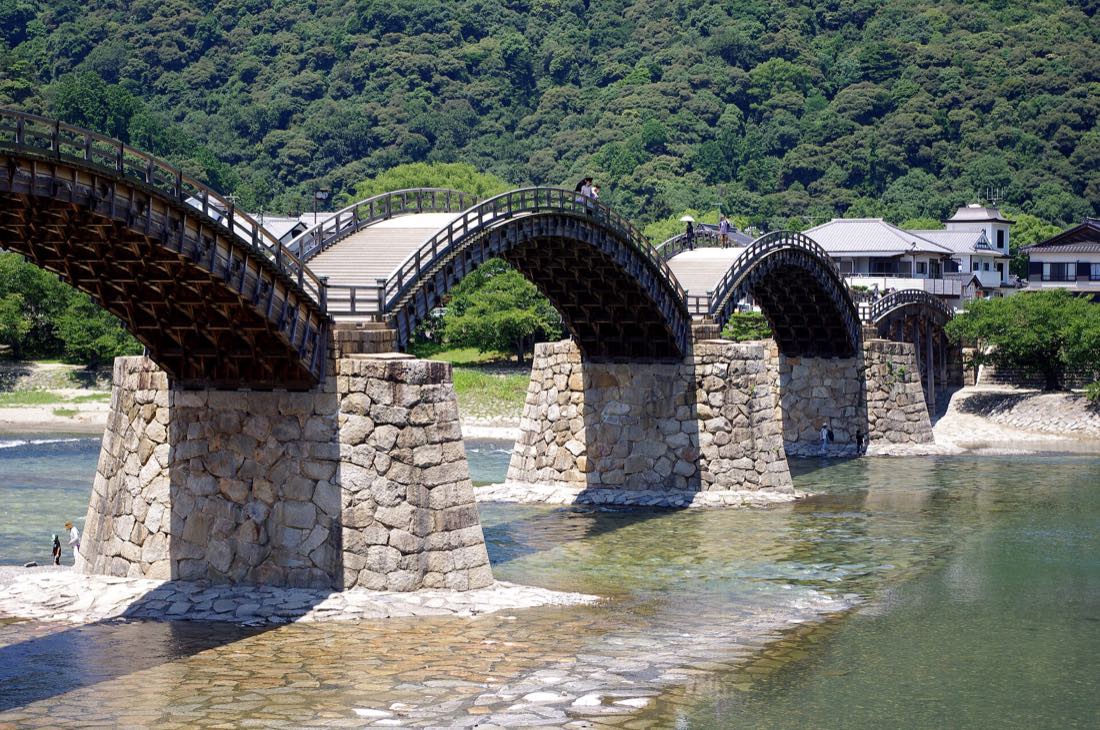
The Kintai Bridge — Kintaikyo — is a sequence of five timber arches spanning the Nishiki River. The original dates from the 1670s; the current structure is a post-war rebuild after a typhoon took the bridge out in 1950, and it has been periodically rebuilt since using the same joinery. Walking it is the experience: the arches are steep enough that you climb and descend five times in about ten minutes, and the timber moves slightly under a crowd.
On the far bank is Kikko Park, the old samurai quarter, with the ropeway station behind it. The ropeway lifts you to the ridge in a few minutes and Iwakuni Castle is a short walk from the top station — a compact reconstruction rather than an original keep, which matters if you have just read that Hiroshima's own keep closed permanently on 22 March 2026. Iwakuni's is open; it is also small, and the reason to go up is the view back down over the bridge and the river bend. Allow 1.5–2 hours for the whole site.
What is still unverified: the rail fare and the journey time from Hiroshima. Iwakuni is served by the JR Sanyo Line and then a bus, and we could not close out either number on 4 August 2026 — check JR West. Also unverified: cormorant fishing (ukai) on the river on summer evenings, whose dates, boat prices and booking arrangements we could not confirm. Dollar prices convert at ¥157.7 = $1, the rate on 4 August 2026. Treat every $ figure as a snapshot and the ¥ figure as the real price.
One geographic point with money attached: Iwakuni is in Yamaguchi Prefecture, not Hiroshima Prefecture. That means the ¥200 per person per night Hiroshima prefectural accommodation tax introduced on 1 April 2026 does not apply here, and it also means Iwakuni sits outside every Hiroshima-prefecture tourism listing you have been reading.
Kintai Bridge and Iwakuni Castle, practically
Plan your visitWhat Iwakuni costs before and after 1 September 2026
The price changeVerified from Iwakuni City. Dollar figures convert at ¥157.7 = $1, the rate on 4 August 2026.
| Ticket | To 31 August 2026 | From 1 September 2026 | Change |
|---|---|---|---|
| Bridge crossing, adult (junior high and up) | ¥310 · $1.97 | ¥500 · $3.17 | +61% |
| Bridge crossing, elementary | ¥150 · $0.95 | ¥250 · $1.59 | +67% |
| Set ticket (bridge + ropeway + castle), adult | ¥970 individual · $6.15 | ¥1,550 · $9.83 | about +60% |
| Set ticket, child | ¥460 · $2.92 | ¥700 · $4.44 | about +52% |
| Crossing after the ticket office shuts | Honesty box | Honesty box | Unchanged — and open 24h |
Treat the set-ticket percentages as approximate. The city's own comparison table pairs ¥1,550 against ¥760, but ¥760 is the group rate rather than the individual ¥970, so the headline rise you will see quoted elsewhere may be overstated. The bridge-only figures are unambiguous. Dollar prices convert at ¥157.7 = $1, the rate on 4 August 2026. Treat every $ figure as a snapshot and the ¥ figure as the real price.
Bridge only, or bridge plus castle?
ComparedThe real decision at the kiosk is how far up the hill you are going — and it is a one-shot decision, because a bridge-only ticket cannot be upgraded to the set ticket afterwards.
| Version | Time on site | What you get | Price from 1 Sept | Verdict |
|---|---|---|---|---|
| Bridge only, both banks | 45–60 min | The five arches on foot, the riverbank view, Kikko Park and the old samurai streets | ¥500 adult | WORTH IT |
| Set ticket — bridge + ropeway + castle | 1.5–2 hours | All of the above plus the ridge view back down over the river bend and a compact reconstructed keep | ¥1,550 adult | WORTH IT |
| Bridge + walk up, no ropeway | 2.5–3 hours | The same castle, reached by a steep wooded path instead of a cable | ¥500 + castle admission | DEPENDS |
| The bridge at night, on the honesty box | 20–30 min | The arches with nobody on them. Lights off after 22:00, so bring a torch | ¥500 in the box | WORTH IT |
| Iwakuni as a full day | 6–8 hours | Adds the white-snake museum, the art museum and a long lunch. Runs out of material before it runs out of daylight | As above | SKIP |
| Iwakuni + Miyajima in one day | 10–11 hours | Two famous sights, both rushed, with a tide you will not get to choose | Guided combinations exist | DEPENDS |
The DEPENDS on walking up: do it if you want a 30-minute climb, skip it in August, when the regional average daily maximum is 32.8°C and the overnight low is 25.1°C — the city does not cool down. The DEPENDS on the Miyajima combination: it works only if you accept that the tide picks itself — above 250cm the torii floats, below 100cm you walk to it, and a fixed tour schedule gives you whichever you are given.
Is Iwakuni your trip?
Who it suitsGuided Iwakuni, if you want the transfers handled
Booking and getting thereIwakuni is easy enough to do independently that a guide is a preference rather than a necessity — one train and one bus. Where guiding earns its money is the castle-town history, which is unlabelled in English. We do not publish tour prices, ratings or review counts because we have not verified them; open a link for live pricing.
Kintai Bridge — the questions people actually ask
FAQPage schema pairedHow much does it cost to cross the Kintai Bridge?
¥310 for adults ($1.97) until 31 August 2026, then ¥500 ($3.17) from 1 September — a 61% rise announced by Iwakuni City. Elementary-age children go from ¥150 to ¥250. The set ticket adding the ropeway and Iwakuni Castle goes to ¥1,550 adult and ¥700 child. Every English page quoting ¥310 as the current price will be wrong from 1 September.
Can I walk across the Kintai Bridge at night?
Yes. The ticket office runs 8:00–17:00 — to 18:00 in peak seasons and 19:00 in summer — but the bridge is designated open 24 hours and operates on an honesty box outside office hours. The fare is the same. Bridge lights go off after 22:00, so a late crossing means bringing a torch and getting the arches to yourself.
Should I buy the set ticket or the bridge-only ticket?
Decide before you pay, because a bridge-only ticket cannot be upgraded to the set ticket afterwards. From 1 September the bridge alone is ¥500 and the set is ¥1,550, so the ropeway and castle effectively cost ¥1,050 ($6.66). Take the set if the weather is clear and you want the ridge view; take the bridge alone if you are here for the arches and lunch.
How do I get to the Kintai Bridge from Hiroshima?
JR Sanyo line from Hiroshima Station to Iwakuni, roughly 50 minutes, then a local bus of about 15–20 minutes to the Kintaikyo stop. Do not aim for Shin-Iwakuni, the shinkansen station — it is a separate station some way from the bridge. The rail fare is not verified; check JR West.
How long do you need at Iwakuni?
1.5–2 hours on site is the honest figure — about 1 hour for the bridge and the riverbank, plus the ropeway and castle — and 4–6 hours door to door from Hiroshima including travel. Trying to make it a full day means adding the white-snake museum and a long lunch, which is padding.
Is Iwakuni Castle worth going up for?
Yes for the view, not for the building. It is a 1960s reconstruction, compact inside, and the reason to ride up is looking back down at the five arches and the river bend from the ridge — about 20 minutes at the top is enough. From 1 September the ropeway and castle add ¥1,050 to the ¥500 bridge fare, which is a fair price for the ridge and a poor one for the keep alone.
When is the best time to visit Iwakuni?
Late November for river colour, or 28 March to 8 April for blossom — the JMA normal first bloom is 25 March and full bloom 3 April — with the caveat that both bring coaches. And before 31 August 2026, if you want the ¥310 fare. Avoid the middle of an August day: the regional average daily maximum is 32.8°C, the overnight low averages 25.1°C, and there is no shade on the bridge.
Iwakuni or Kure, if I only have one day trip?
Kure if the weather is bad or you like museums; Iwakuni if it is clear and you want to look at something beautiful for an afternoon. Kure is about 40 minutes out and both of its museums are indoors, which settles it on any wet day. If your dates fall before 31 August 2026, Iwakuni has a ¥190 argument the other way.
That is the case for it.
Iwakuni is a day trip for 99% of visitors, which means the bridge at 07:00 and the bridge after 22:00 — lights off, honesty box, arches to yourself — belong to whoever stayed. Rooms here are considerably cheaper than Hiroshima's, and there is a second saving nobody mentions: Iwakuni is in Yamaguchi Prefecture, so the ¥200 per person per night Hiroshima prefectural accommodation tax introduced on 1 April 2026 does not apply. It only makes sense if you are moving west afterwards — if you are coming back to Hiroshima, do not bother.
Compare Iwakuni hotels