Almost everything
is permitted.
Almost nobody does it.
The questions people are too embarrassed to type, answered without piety. Photography inside the museum is allowed. The whole park is non-smoking and that is the only hard posted rule. The real constraints here are social, and they are much stronger than anything written on a sign.
Photography and video are allowed inside the museum, without flash, for personal use — including the Main Building. The widespread claim that cameras are banned inside is false. No tripods, no selfie sticks, no large bags, no phone calls in the galleries. The entire park is non-smoking, and that is the only hard posted prohibition in it. Everything else that governs behaviour here is a norm, not a rule.
The rule and the norm are not the same thing
Start hereMost guides to conduct in Peace Memorial Park err heavily towards piety and get the facts wrong in the process. There is no published code of conduct for the park at all — which is itself worth saying — and the museum's actual rules are shorter and more permissive than the internet believes.
The useful frame is this: the written rules tell you what you will be stopped for, and there is almost nothing on that list. What governs the park is what the two hundred people around you are doing, and that is a far tighter constraint. The gap between permitted and done is the single most useful thing anyone can tell you before you arrive.
So this page gives you both columns. What you may do, from the museum's own rules. And what actually happens in the room, so that you can decide for yourself rather than find out from a stranger's expression.
What is actually posted
The rulesShort list. Everything not on it is permitted.
Every part of Peace Memorial Park, outdoors included. This is the only hard posted prohibition covering the park as a whole, and there is no published code of conduct beyond it.
Without flash, for personal use, throughout the museum. There is no gallery-specific ban — the rule is uniform across the building, including the Main Building where the tricycle, the school uniform and the donated skin and hair are.
The common claim that photography is forbidden inside is falseAnywhere in the museum. Handheld only, and keep the flash off — it is the one photographic rule staff will actually intervene on.
Coin lockers are on the 1st floor of the East Building. Day packs are usually fine; suitcases are not.
Silence your phone. Eating and drinking are confined to the 1st-floor Visitor's Lounge — not the galleries, not the corridors.
In writing, to the museum, in advance. Personal photography needs nothing. If you are shooting anything that will be monetised, that is the line you are on the wrong side of.
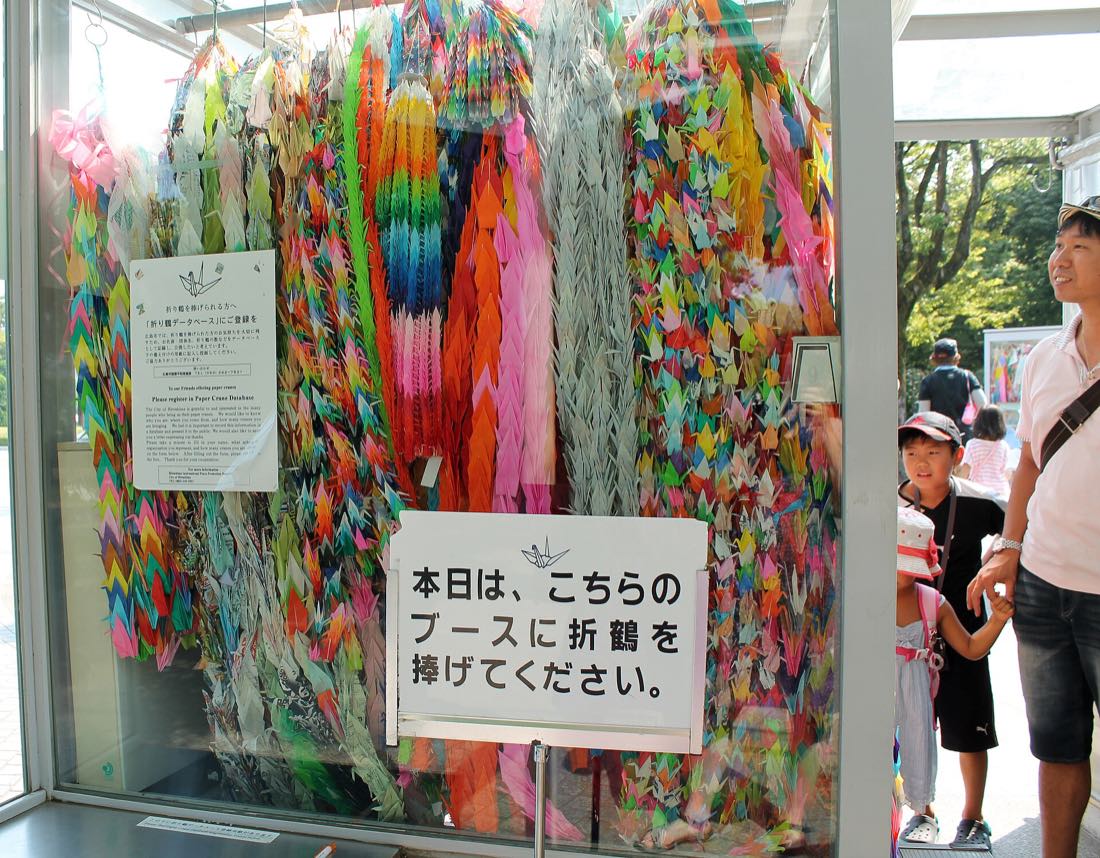
Anyone may offer paper cranes at the Children's Peace Monument, freely and with no registration or paperwork. They go into the dedicated glass booths around the monument. Booths are open 08:45–17:00 daily, and 06:00–20:00 on 6 August.
The two columns nobody prints side by side
Permitted vs doneThe left column is the rule. The right column is what happens in the room. Where they disagree, the right column is the one that will make you uncomfortable.
| Situation | The rule | What actually happens |
|---|---|---|
| Photographing the exhibits | Permitted, no flash, personal use | Common in the East Building's historical sections. Nobody looks twice. |
| Photographing the Main Building | Permitted. There is no gallery-specific ban | Almost nobody does it, and the room is silent. Nothing stops you photographing the tricycle or the uniform. Notice what everyone else has decided, and then make your own decision. |
| Peace signs at the A-Bomb Dome | No rule of any kind | In the Chugoku Shimbun's survey of 50 people at the Dome, 70% said it made them uncomfortable and 24% saw no problem. |
| Offering paper cranes | Permitted for anyone, no paperwork | Constant, from schoolchildren, tour groups and solo visitors. Nobody will ask who you are. |
| Eating in the park | No prohibition outdoors | People eat on the benches by the river. Inside the museum it is the 1st-floor lounge only. |
| Smoking | Banned park-wide | Enforced socially and quickly. This is the one thing you will be spoken to about. |
| Wearing whatever you turned up in | No dress code exists | Nobody is dressed formally except on 6 August. Beachwear stands out; everything else does not. |
| Filming for a channel | Needs a written application | The only genuinely bureaucratic item on this page. |
Museum conduct rules as published by the museum, checked 4 August 2026. The park has no published code of conduct.
Nobody will stop you. A large majority will wish you hadn't
The peace signThis is the question people search for at 23:00 the night before, and the honest answer has two halves. There is no rule, no sign and no enforcement. And when the Chugoku Shimbun's Peace Media Center put the question to 50 people standing at the A-Bomb Dome, 70% said seeing visitors flash peace signs there made them uncomfortable while 24% saw no problem with it.
The failure mode is thoughtlessness rather than malice, and one of the people defending the practice said so himself: the Dome, in his words, is a "tourist spot", so he posed in front of it as he always does — without thinking. That is the whole thing. Nobody is accusing you of anything. They are noticing that your body did the thing it does at every other landmark, at a place where 140,000 people died.
The peace educator Seiji Horie has argued explicitly against banning it, on the grounds that forcing people not to make a peace sign would not help them think more deeply. We agree, which is why this page issues no rules. Take the photograph you want to take. Just take it having read the number.
Anyone may offer them, and nothing is thrown away
Paper cranesThere is no application, no registration and no fee. You fold a crane — or a thousand, or one — and you put it in one of the glass booths around the Children's Peace Monument. The booths are open 08:45 to 17:00 daily and 06:00 to 20:00 on 6 August. Curtains are drawn across them at night, which is a precaution against vandalism rather than a closing time.
Two things people worry about, both answerable. Cranes may also be posted to the city from abroad, and they are accepted. And offered cranes are not discarded — the city passes them to organisations that repurpose the paper, so the thousand you folded at home does not end up in a bin in March.
Cranes go in the booths, not draped on the statue. That is the only part of this with a right answer. If you are travelling with children, folding one at the hotel the night before gives them a reason to be standing there at all — see the page on visiting with children.
The inscription with no subject, and the man with the chisel
The CenotaphThe Cenotaph reads, in the usual English rendering: "Let all the souls here rest in peace, for we shall not repeat the evil." In Japanese the sentence has no grammatical subject. Who "we" refers to — the Japanese, the Americans, humanity — has been argued about for seventy years, and the ambiguity is not an accident of translation.
The city's official position is that it is a pledge by all people never to repeat the error that is war, not an admission of guilt by any one nation. That reading has never satisfied everyone. In 2005 a man attacked the stone with a hammer and chisel because he objected to the word "error" — he believed it assigned blame to Japan — and the damage was severe enough that the stone had to be replaced.
Do not let a guide flatten this into a nice line about peace. The argument is part of the monument, and standing there knowing that the sentence is deliberately unowned is a different experience from standing there having read a plaque.
This is not "dark tourism", and the city has said so
The labelHiroshima's own visitor portal is branded Peace Tourism. The other term is an outsider academic label the city has visibly declined, and using it here is a tell that a writer has not looked at what Hiroshima calls itself.
The useful academic test comes from Professor Hideki Endo: a site of this kind counts as tourism of that sort only if visitors "miss, grieve and pray for" the victims. Which is precisely the test a ranked listicle fails. It is also why this site does not rank or badge the museum, the park, the Dome or the Cenotaph — see the wider page on Hiroshima's unwritten rules, including the question about being American, which deserves a straight answer and gets one there.
We don't put a verdict badge on the Peace Memorial Museum, the Park, the Dome or the Cenotaph. They aren't purchases to be assessed, and ¥200 against 140,000 dead isn't a value calculation. Where a guided tour of them is worth the money we say so about the tour, not about the place.
The practical bit
Plan your visitConduct and photography — the awkward questions
FAQPage schema pairedCan you take photos inside the Hiroshima Peace Memorial Museum?
Yes. Photography and video are permitted throughout the museum for personal use, without flash. The frequently repeated claim that photography is banned inside is simply false. What is not allowed: tripods, selfie sticks, large bags in the galleries (lockers are on the 1st floor of the East Building) and phone calls in the exhibition rooms.
Is there a photography ban in the Main Building?
No. The rule is uniform across the whole museum, including the Main Building where the tricycle, the school uniform and the donated skin and hair are displayed. The honest point is not a rule but a norm: nothing stops you photographing that room, almost nobody does, and it is silent. That gap is worth knowing before you raise a camera.
Is it disrespectful to take a peace-sign photo at the A-Bomb Dome?
There is no rule against it and nobody will stop you. When the Chugoku Shimbun's Peace Media Center asked 50 people standing at the Dome, 70% said it made them uncomfortable and 24% saw no problem. One defender's own explanation was that the Dome is a "tourist spot" so he posed as he always does, "without thinking". Peace educator Seiji Horie has argued against any ban.
Can anyone leave paper cranes at the Children's Peace Monument?
Yes — anyone, freely, with no registration or paperwork of any kind. They go in the dedicated glass booths around the monument rather than on the statue. Booths are open 08:45–17:00 daily and 06:00–20:00 on 6 August, and curtains are drawn at night to protect the paper from vandalism. Cranes can also be posted to the city, and offered cranes are not discarded — they are handed to organisations that repurpose the paper.
What does the Cenotaph inscription actually mean?
"Let all the souls here rest in peace, for we shall not repeat the evil" — a sentence that in Japanese has no grammatical subject, so who "we" refers to has been contested for 70 years. The city's official position is that it is a pledge by all people never to repeat the error that is war, not an admission by any one nation. In 2005 a man attacked the stone with a hammer and chisel over the word "error" and it had to be replaced.
Are there dress codes or silence rules in the Peace Memorial Park?
None are published. The entire park is non-smoking and that is the only hard posted prohibition; there is no dress code, no eating ban outdoors and no enforced silence. On 6 August the register shifts sharply — that day has bag checks, metal detectors and a banned-items list, covered on the ceremony page.
Do I need permission to film in the park or museum?
Not for personal photography or video. Commercial or press filming requires a written application to the museum in advance. If the footage is going anywhere monetised, apply — this is the one genuinely bureaucratic item in the park.
Is visiting Hiroshima "dark tourism"?
The city does not use the term and has visibly declined it — its own portal is branded Peace Tourism. Professor Hideki Endo's test is that a site counts only if visitors "miss, grieve and pray for" the victims, which is exactly the test a ranked listicle fails. It is also why nothing in this park carries a score on this site.
Booking and getting there
PracticalNone of the above costs anything. If you would rather have the context spoken than read, these are the guided options — placed here, at the foot, deliberately.