Free things to do in Hiroshima,
including the ones nobody lists.
A free daily talk in English at 13:00 with no booking. A newly opened A-bombed hospital building, free since 1 May 2026. Memoir readings on the second Sunday of the month. The castle grounds, now that the keep has closed. Hours and tram stops for all of it.
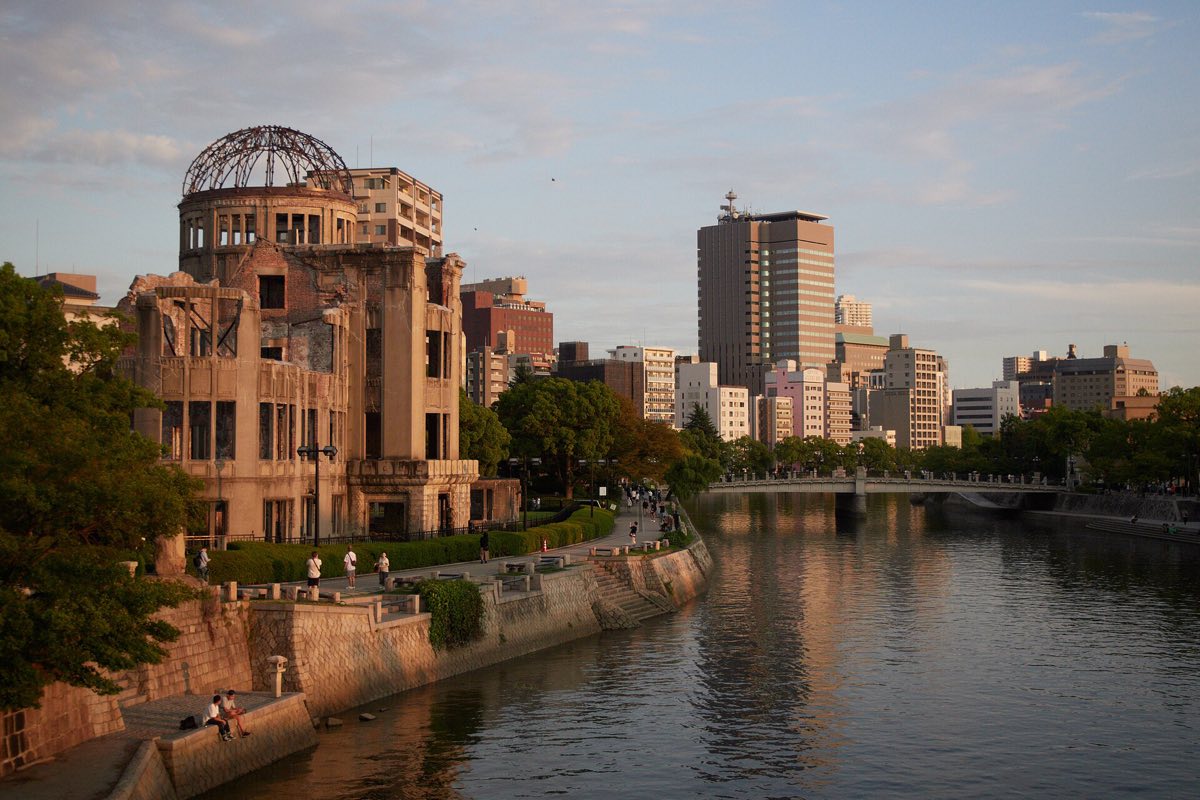
Hiroshima is unusually generous to people spending nothing. The Peace Memorial Park, the A-Bomb Dome and the National Peace Memorial Hall are all free and always have been. So are the castle grounds, now that the keep has closed permanently. Three free things almost nobody publishes: the 13:00 English testimony talk, the memoir readings at the Memorial Hall, and the Teishin Hospital annex, which opened on 1 May 2026. Two full days of this city can be done for the price of tram fares.
Start with the free things that are not on anyone else's list
The three nobody publishesTwo of these are the most valuable hours available in Hiroshima at any price, and the third opened three months ago.
1. The daily English talk, 13:00, free, no reservation. Every day except 30–31 December and the February exhibit-change closure, the Peace Memorial Museum runs a 60-minute talk in English in the East Building, Basement 1, Special Exhibition Room. It includes questions. There is no booking, no fee and no group requirement — a solo traveller walks in. It is delivered by a denshosha, an A-bomb legacy successor: a trained non-survivor who has spent years learning one specific survivor's testimony in order to carry it. As of 1 April 2026 there are 264 legacy successors and 48 family successors against roughly 32 living survivor testifiers, and the 91,000 hibakusha nationwide have an average age of 86.66. That is why the programme exists, and it is not a substitute for anything. Details on the testimony page.
2. The memoir readings at the National Peace Memorial Hall. Forty minutes, free, no booking, in the B1 Training Room 3: readings of survivors' written memoirs. In English on the 2nd Sunday and 4th Friday at 14:30–15:10, and the 3rd Tuesday at 11:00–11:40. Almost no English-language source carries these times. If your dates line up, it is one of the quietest and most affecting hours in the city.
3. The Teishin Hospital annex, free and new. The Former Hiroshima Teishin Hospital Outpatient Wing Peace Museum opened on 1 May 2026 as an official auxiliary facility of the Peace Memorial Museum. Free, 09:00–17:00, closed Mondays, no reservation. It is a 1935 A-bombed building 1,370m from the hypocentre that became one of the few functioning relief stations after the bombing, restored for about ¥280 million with around 60 exhibits, a recreated sterile surgical room, exposed A-bombed roof tiles and a 20-minute film screened hourly at :10 and :40 with Japanese and English subtitles and sign language. It is not in the Peace Memorial Park — it is 1.5 to 2km north-east, Hiroden Hakushima line to Katei-Saibansho-mae, then two minutes on foot. Full detail on the annex page.
4. The G7 Hiroshima Summit Memorial Museum — free, and almost nobody covers it. It opened on 19 May 2024 inside Peace Memorial Park, it costs nothing, and it keeps the same seasonal hours as the Peace Memorial Museum — which means 7:30–20:00 in August — closing only on 30–31 December. Inside are the actual round table and chairs the G7 leaders used at the 2023 summit, and a logo object made from atomic-bombed trees. It takes 20 to 30 minutes and it is fifty metres from things you were already going to see.
One correction while we are here: the museum's free Peace Volunteers give commentary in the park, but the museum states that in-museum exhibit commentary is currently suspended. If you were counting on a free guide inside the building, plan otherwise.
Fifteen free things, with hours and how to get there
The listEverything in this table costs ¥0. Tram fares are extra and flat: ¥240 ($1.52) a ride, or ¥700 ($4.44) for the day pass, which pays from ride three. No verdict column here — several of these are memorial sites, and we do not score them.
| Free thing | Hours | Time needed | Getting there | Booking |
|---|---|---|---|---|
| Peace Memorial Park | Always open | 45–90 min | Hiroden line 2 or 6 to Genbaku Dome-mae, ~15 min from the station | None |
| A-Bomb Dome (Genbaku Dome) | Always open, exterior only | 15 min | Genbaku Dome-mae, on the doorstep | None |
| National Peace Memorial Hall | Free entry; 09:00–20:00 on 6 August | 30–45 min | Inside the park | None |
| Memoir readings, Memorial Hall B1 | English: 2nd Sun and 4th Fri 14:30–15:10 · 3rd Tue 11:00–11:40 | 40 min | Inside the park | None |
| The 13:00 English legacy-successor talk | 13:00–14:00 daily, East Building B1 | 60 min | Inside the museum building | None |
| Teishin Hospital annex (opened 1 May 2026) | 09:00–17:00, closed Mondays | 45 min | Hiroden Hakushima line to Katei-Saibansho-mae, 2 min walk | None |
| Paper cranes at the Children's Peace Monument | Booths 08:45–17:00 daily · 06:00–20:00 on 6 August | 15 min | Inside the park | None — no registration or paperwork |
| G7 Hiroshima Summit Memorial Museum (opened 19 May 2024) | Same seasonal hours as the Peace Museum — 7:30–20:00 in August · closed 30–31 Dec | 20–30 min | Inside Peace Memorial Park | None |
| Hiroshima Castle grounds and Ninomaru | Grounds 09:00–17:30 · to 16:30 Oct–Mar. Ninomaru closed 8 Dec and 29–31 Dec. Keep closed permanently | 45 min | Hiroden 1, 2 or 6 to Kamiyacho-nishi, ~12 min walk | None |
| Mitaki-dera and its three waterfalls | Daylight hours | 90 min door to door | JR Kabe line to Mitaki, then 15 min uphill | None |
| Hondori and the covered arcades | Walkable 24h; shops ~10:00–20:00 | 30 min | Hiroden to Kamiyacho-higashi or Hatchobori | None |
| The Motoyasu and Ota riverbanks | Always open; best after dark | 30–60 min | Along the park's edges | None |
| The illuminated A-Bomb Dome after dark | Always | 20 min | Genbaku Dome-mae | None |
| Mazda Museum | Mon–Fri plus 5 Sep, 10 Oct, 7 Nov, 5 Dec 2026 · closed 8–17 Aug 2026 | An afternoon | JR Sanyo line to Mukainada | Required — online only, no walk-ups |
| Peace Volunteers park commentary | Daytime; in-museum commentary is currently suspended | 60 min | Inside the park | Ask at the museum |
On 5 and 6 August 2026 there are additional free sessions with actual survivor testimony in English at the Hiroshima International Conference Center inside the park — 10:00–12:30 and 13:00–14:00 on the 6th, no booking. That is the rarest thing available in this city and it exists for two days a year. See the 6 August page before you plan around it, because the park is closed to the public 05:00–09:00 that morning.
What to spend on, if you are spending anything
The paid things worth the moneyThree admissions between them cover almost everything a free day misses, and they total under ¥800.
¥200 ($1.27) — the Peace Memorial Museum. High-school students and over-65s with a passport pay ¥100; junior-high and under are free. The audio guide is ¥500 ($3.17) in 15 languages, about 70 minutes. Allow two hours inside, three if you read properly. From 8 to 16 August 2026 the Peace Memorial Museum takes no walk-ups at all: online reservation only, capped at 1,000 people an hour, released 90 days ahead. Outside that window the 11:00–14:00 block is pre-booked entry only. The museum opens at 7:30 and almost nobody uses it.
¥350 ($2.22) — Shukkeien Garden. Forty minutes, the best value of any admission in the city, and ten minutes' walk from the castle grounds. It is free if you are 65+ with ID or in high school and under, and free for everyone on 4 May and 3 November.
¥100 ($0.63) — Hokoku Shrine, inside the castle grounds, 08:30–16:30. Optional, and the only charge left on that site.
That is ¥650 ($4.12) for the three, or ¥1,150 ($7.29) with the audio guide. Add ¥700 ($4.44) for a day of trams and you have a complete Hiroshima day for well under ¥2,000. Hiroden went to a flat ¥240 adult / ¥120 child fare on 1 February 2025, its first revision in seven years, replacing the old distance-based ¥140–270 scale. The all-day streetcar pass is ¥700, so it pays from your third ride — which is exactly what a Peace Park, castle and station day comes to.
Dollar prices convert at ¥157.7 = $1, the rate on 4 August 2026. Treat every $ figure as a snapshot and the ¥ figure as the real price.
A free day in Hiroshima, practically
Plan your visitFree things to do in Hiroshima — common questions
FAQPage schema pairedIs the Peace Memorial Park free?
Yes — the park, the Cenotaph, the Children's Peace Monument and the A-Bomb Dome are free and open at all hours, and the National Peace Memorial Hall is free too. Only the museum charges, at ¥200 ($1.27). The one exception is 6 August, when the park is closed to the public 05:00–09:00 for the ceremony.
Can you hear a survivor's testimony for free in Hiroshima?
Yes, daily, in English, with no booking: 13:00–14:00 in the museum's East Building Basement 1, 60 minutes including questions. It is given by a trained legacy successor rather than a survivor — as of 1 April 2026 there are 264 legacy successors against roughly 32 living survivor testifiers. Full detail on the testimony page.
What is the new free museum in Hiroshima?
The Former Hiroshima Teishin Hospital Outpatient Wing Peace Museum, which opened on 1 May 2026. Free, 09:00–17:00, closed Mondays, no reservation. It is a 1935 A-bombed building 1,370m from the hypocentre, about 1.5–2km north-east of the park — Hiroden Hakushima line to Katei-Saibansho-mae.
Is Hiroshima Castle free now?
The grounds, moat, bomb-scarred stone walls, Ninomaru reconstruction and Gokoku Shrine are free, 09:00–17:30 and to 16:30 from October to March. Hiroshima Castle's keep closed to the public on 22 March 2026 — after 68 years — because the 1958 reinforced-concrete reconstruction no longer met earthquake standards. A wooden rebuild is planned but years out. The grounds, the moat, the bomb-scarred stone walls and the Ninomaru reconstruction are all still open, and all still free. The tower you came to go inside is not. The new Sannomaru quarter, opened 29 March 2026, is free to walk into as well — you only pay for what you eat.
What can you do in Hiroshima with no money?
A full two days: the park and the Dome, the 13:00 English talk, the Memorial Hall and its memoir readings, the G7 Summit Memorial Museum, the Teishin annex, the castle grounds and the new Sannomaru quarter, Mitaki-dera, the covered arcades and the riverbanks after dark. Your only unavoidable cost is transport — ¥700 ($4.44) a day if you use the pass. One charge that is not in your prepaid hotel total: a ¥200 per person per night prefectural accommodation tax since 1 April 2026 on rooms of ¥6,000 or more, collected at the desk. Run the rest on what Hiroshima costs.
What is the G7 Summit Memorial Museum in Hiroshima?
A free museum inside Peace Memorial Park, opened 19 May 2024, holding the actual round table and chairs the G7 leaders used at the 2023 summit and a logo object made from atomic-bombed trees. It keeps the Peace Memorial Museum's seasonal hours — 7:30–20:00 in August — and closes only on 30–31 December. Twenty to thirty minutes, and almost no guide mentions it.
Are there free guided tours in Hiroshima?
The museum-affiliated Peace Volunteers give free commentary in the park, but the museum states that in-museum exhibit commentary is currently suspended — so do not count on a free guide inside the building. Independent volunteers with Hiroshima Interpreters for Peace charge about ¥2,000 per volunteer for a 1.5-hour English park tour, usually two of them, and ask for at least 10 days' notice. Compared on tour versus self-guided.
Can you fold and offer paper cranes for free?
Yes. Anyone may offer cranes at the Children's Peace Monument with no registration and no paperwork. They go in the dedicated booths around the monument rather than on the statue, open 08:45–17:00 daily and 06:00–20:00 on 6 August. Offered cranes are not thrown away — the city passes them to groups who repurpose them.
If you decide to pay for one thing
Booking and getting thereEverything above is free and needs nothing booked. These are here for the day you want a guide or the transport handled. We do not republish prices, ratings or review counts.