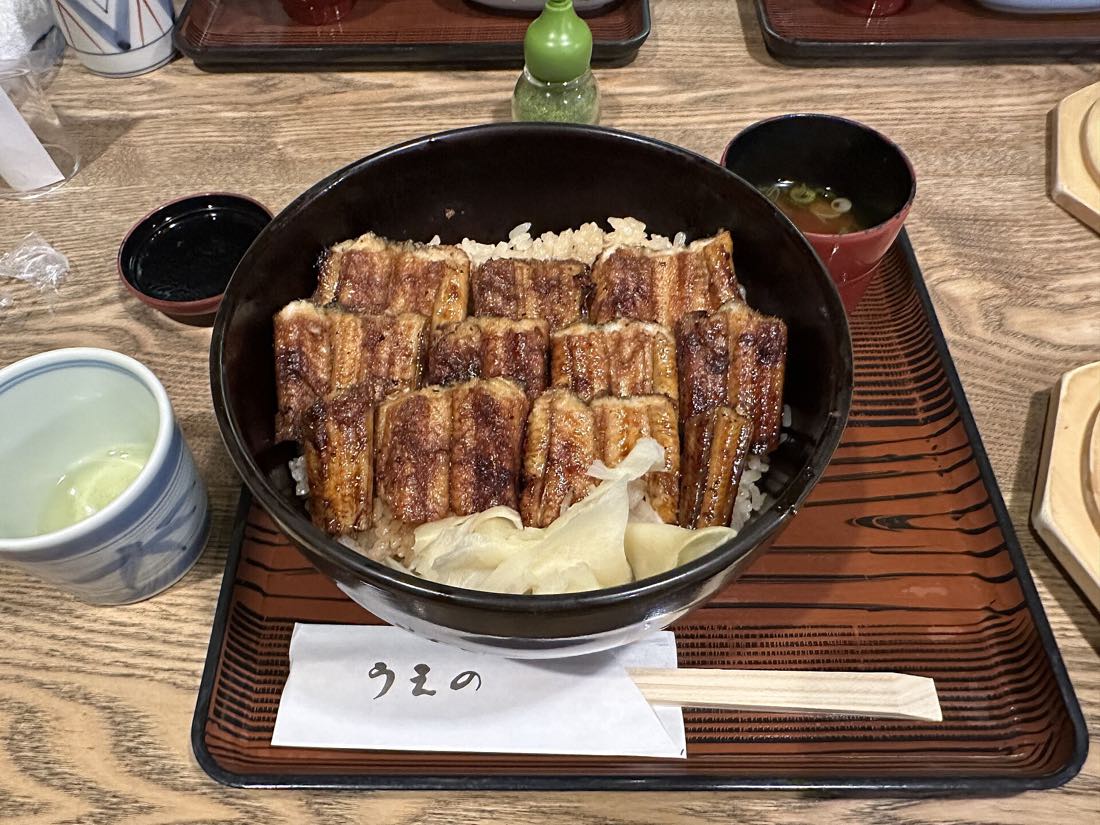
Miyajima food:
eel by the ferry,
oysters in winter,
maple cakes all year.
Three things define eating here. Anago-meshi — conger eel over rice — is the Miyajimaguchi dish and Ueno is the shop that made it famous. Oysters are a winter product, roughly October to March, so a July visit finds the farmed summer variety and a lot of places simply not doing them. Momiji manju are everywhere, and the fried ones are the ones to have.
Eat anago-meshi, and eat it at Miyajimaguchi rather than on the island — the mainland ferry side is where the dish belongs and where Ueno sits, about a minute from the station. Budget ¥2,500–3,000; the bento counter runs 09:00–19:00 and the dining hall 10:00–19:00, and both close when they sell out, which is the real constraint. Grilled oysters are winter — roughly October to March, peaking December to February — and street stalls run about ¥400–600 a pair. Momiji manju are everywhere, and the fried Age-momiji is the version worth queuing for.
Anago-meshi first, and preferably on the mainland
What to eatConger eel, grilled, sliced and laid over rice cooked in its stock. It is the Miyajimaguchi speciality — the ferry terminal side, not the island — and it has been for over a century.
Ueno is the name to know: the shop about a minute from Miyajimaguchi station that turned anago-meshi from a station bento into a dish people plan a day around. Bento counter 09:00–19:00, dining hall 10:00–19:00, open year-round, price band ¥2,500–3,000. ⭐ The detail that matters more than the hours: an advance order does not let you skip the queue — the shop states that walk-ins and pre-orders join the same line, so you reserve to guarantee the food, not to save time. Both counters close when they sell out. If it has gone, there is a second Ueno at Hiroshima Mitsukoshi B1F, and Ajiroya at Hiroshima Station's shinkansen gate runs 06:00–20:00.
Grilled oysters on the island: Yakigaki no Hayashi, founded 1948, runs 10:30–17:00 with last orders at 16:30, and the street stalls along Omotesandō do a pair for roughly ¥400–600. Where we still cannot give you a number we say so — momiji manju is not priced per skewer by any source we could verify, so check the counter.
⚠ One correction worth carrying: the Miyajima Oyster Festival was cancelled in February 2026, because the organisers could not secure enough oysters after poor growth. 2027 is unconfirmed. Nearly every travel site still lists it as an annual fixture, and a reader building February dates around it would arrive to nothing.
Hiroshima oysters are a winter dish — roughly October to March, peaking December to February. Come in July and you'll find the farmed summer Kaki Komachi variety and a lot of restaurants simply not doing oysters. The grilled-oyster stalls and the festivals are a November-to-March thing.
On the island itself, Omotesando is the covered shopping street running from the pier towards the shrine and it is where the food is: grilled oysters on skewers in season, fried momiji manju, croquettes, and the queue. It shuts early — with the day-trippers, from around 17:00 — which is one more reason the 16:00 arrival is the worst plan on the island.
Two warnings that are not about food quality. Eat away from the waterfront — the deer have learned exactly what a paper food bag means. And eat before 17:00: Yakigaki no Hayashi shuts at 17:00, Momijidō's main shop at 17:30, and after that the island has very little, which is why ryokan dinners are effectively compulsory.
What to eat on Miyajima, and when
The listVerified prices where they exist, and an honest blank where they do not.
| Dish | Where | Season | Verdict |
|---|---|---|---|
| Anago-meshi (conger eel over rice) · ¥2,500–3,000 | Ueno, ~1 min from Miyajimaguchi station. Bento 09:00–19:00, dining hall 10:00–19:00 — both close when sold out | All year | WORTH IT |
| Grilled oysters on a skewer · ~¥400–600 a pair | Omotesandō stalls, and Yakigaki no Hayashi 10:30–17:00 (LO 16:30) | Roughly Oct–Mar, peak Dec–Feb | WORTH IT |
| Raw or steamed oysters | Island restaurants and the city's oyster bars | Winter — though triploid summer natsu-kaki now exist and the tourism board pushes them | DEPENDS |
| Momiji manju, steamed · price per piece not published | The length of Omotesandō | All year | DEPENDS |
| Age-momiji® — fried momiji manju | Momijidō invented it in 2002 and trademarks it. Main shop 09:00–17:30; the ekie branch at Hiroshima Station runs to 21:00 with no closing days | All year | WORTH IT |
| Hiroshima okonomiyaki | Better in the city than on the island | All year | DEPENDS |
| Oyster curry, oyster ramen and similar | Island tourist restaurants | Winter | SKIP |
Layered okonomiyaki with noodles is Hiroshima's version and it is a city dish — do it properly at a counter in Naka-ku rather than on Omotesando. The okonomiyaki page has the where and the how.
The oyster calendar, which decides half this page
By monthHiroshima produces the majority of Japan's oysters and the season is the single biggest variable in what you will actually be offered.
Hiroshima oysters are a winter dish — roughly October to March, peaking December to February. Come in July and you'll find the farmed summer Kaki Komachi variety and a lot of restaurants simply not doing oysters. The grilled-oyster stalls and the festivals are a November-to-March thing.
Eating on and around the island
Plan your visitGuided eating, if you want the good counters
Book itFood tours are the one category where a guide reliably beats a search, because the best okonomiyaki and oyster counters in this region are small, unmarked and not set up for visitors. Prices and ratings are not published here — none could be verified.
Miyajima food questions
FAQPage schema pairedWhat food is Miyajima famous for?
Three things: anago-meshi (conger eel over rice, ¥2,500–3,000 at Ueno), oysters roughly October to March, and momiji manju — maple-leaf cakes sold the length of Omotesandō. The eel is the one that is good all year, and the fried Age-momiji is better than the steamed.
Where is the best anago-meshi?
Ueno, about a minute from Miyajimaguchi station on the mainland, in the ¥2,500–3,000 band. Bento counter 09:00–19:00, dining hall 10:00–19:00, and both close when they sell out — that, not the closing time, is what you plan around. An advance order guarantees the food but not a shorter queue; walk-ins and pre-orders share one line.
Can you eat oysters on Miyajima in summer?
Sometimes. The season runs roughly October to March and peaks December to February, but triploid summer oysters — natsu-kaki, which do not spawn — now exist, and the prefecture's tourism board promotes them. In July and August expect a short list and many places serving none at all; the ¥2,500–3,000 anago-meshi is the safer summer plan.
What are momiji manju?
Maple-leaf-shaped cakes, traditionally red bean and now also custard, chocolate and cheese. Get them fried on a stick: Momijidō invented Age-momiji® in 2002 and its main shop runs 09:00–17:30, with the ekie branch at Hiroshima Station open to 21:00 every day. Per-skewer prices are not published by any source we could verify.
How much does food cost on Miyajima?
Anago-meshi at Ueno is ¥2,500–3,000, grilled oysters run about ¥400–600 a pair at the street stalls, and momiji manju per-skewer prices are not published by any source we could verify. A day with a proper anago-meshi lunch and two snacks lands around ¥3,500 per person; a day of stall food lands under ¥1,500.
Is it better to eat on the island or at Miyajimaguchi?
Miyajimaguchi for anago-meshi, the island for oysters and street food. Ueno is about a minute from the trains, so building it into your return journey avoids the island's 12:00–13:30 crush — but go early enough that they have not sold out, because that is when both counters close.
What time do the restaurants on Miyajima close?
Early. Yakigaki no Hayashi takes last orders at 16:30 and shuts at 17:00, Momijidō's main shop closes at 17:30, and most of Omotesandō goes with the day-trippers. If you are staying overnight your ryokan dinner may be the only option after 17:00 — and if you want Age-momiji later, the ekie branch at Hiroshima Station runs to 21:00 every day.
Can I eat while walking on Miyajima?
You can, but the deer have eaten paper since feeding was banned in 2008, and the promenade in front of the shrine is where they patrol. Eat at the stall counters or in the seating areas set back from the water, and keep the bag closed between bites — a ¥300 ferry ticket in an open pocket is the expensive version of this mistake.
Continue planning
Keep decidingEat it with a local
Hiroshima food tours & tastings — guided street-food crawls and cooking classes with vetted operators, most with free cancellation.