Pre-ordering at Ueno
does not
skip the queue
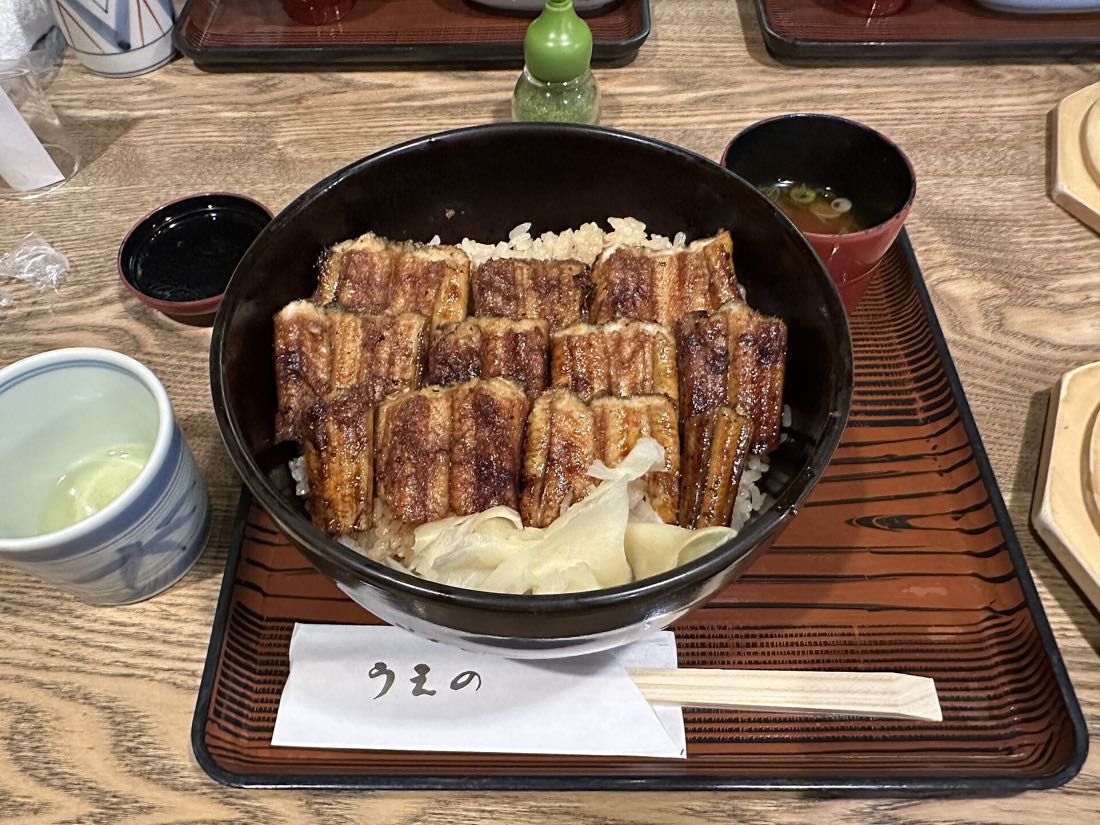
Grilled saltwater conger eel, fanned over rice cooked in stock made from the eel bones, one minute from Miyajimaguchi Station. Every guide tells you to pre-order the bento to beat the line. Ueno's own site says pre-orders and walk-ins join the same queue and are served in order.
Eat it at Ueno, about 1 minute from JR Miyajimaguchi Station, on your Miyajima day. Bento counter 09:00–19:00, dining hall 10:00–19:00 (both to 18:00 on Wednesdays), open year-round — but both close when sold out, and that is the real constraint. Price band ¥2,500–3,000 (about $16–19). You can pre-order a bento up to a month ahead, and it guarantees the food, not a shorter wait.
What anago-meshi is, and why it is here
Answer firstSaltwater conger eel (anago), filleted, grilled and glazed, laid in overlapping strips across a bowl or box of rice that has been cooked in stock made from the eel's own bones and heads. That stock is the whole dish: the rice arrives brown, savoury and seasoned all the way through, rather than white rice with something on top.
It is not the freshwater eel (unagi) most travellers have eaten in Japan. Conger is leaner, lighter, less fatty and more delicate, and the glaze is generally less sweet. If you found unagi too rich, this is the version that will change your mind.
It belongs to Miyajimaguchi — the mainland ferry village opposite the island — because it began as a railway lunch box sold to travellers changing for the boat. Ueno dates its anago-meshi to 1901, which is roughly the age of the railway that created the market for it. That origin is why the dish is a bento as often as it is a served bowl, and why the famous shop sits a minute from the station rather than in central Hiroshima.
Which makes it the single easiest upgrade on this trip. You are going to Miyajima anyway. The ferry leaves from the place the dish comes from. All it costs you is planning.
Pre-ordering guarantees the food, not a shorter queue
The finding⭐ Ueno's own site states that advance-order customers and walk-in customers join the same line and are served in order. That contradicts the advice on a great many travel pages, which present pre-ordering as the way to walk past the queue. It is not. You can reserve a bento up to a month ahead, online or by phone, and what that buys you is certainty that the anago will not have sold out before you arrive — reserve for the food, not for the line.
That distinction matters more than it sounds, because "closes when sold out" is the operative constraint at this shop, not the closing time. The bento counter runs 09:00–19:00 and the dining hall 10:00–19:00 — both to 18:00 on Wednesdays, both open year-round — but nobody should turn up at 18:00 expecting food. Arrive before noon.
Upstairs, Tanikichi runs on different hours again: lunch 11:00–15:00 Monday to Thursday, and lunch plus dinner 17:00–22:00 Friday to Sunday, closed Tuesdays and Wednesdays. Worth knowing if the ground-floor queue is impossible.
⚠️ On price we publish a band, not a figure: ¥2,500–3,000 (about $16–19). Ueno's own menu page currently 404s and the secondary sources conflict, so a single number here would be false precision. One specific warning: the roughly ¥1,890 figure you may find is from Ueno's online mail-order store — that is a shipped product and a different item, and it is not what you will pay at the counter.
A live illustration of how tight this shop runs: for 14–16 August, over Obon, Ueno restricted both reservations and counter sales to the standard (並) size only. If your dates land in that week, plan accordingly and read what else the first half of August does to this city.
Four ways to time it around the ferry
ComparedThe dish costs you a queue, so the only real decision is where in the day you spend it.
| Plan | How it works | Cost to your day | Verdict |
|---|---|---|---|
| Early, before crossing | Reach Miyajimaguchi by 11:00, eat, cross at about 12:00 | 30–45 min, and you land on the island as the morning crowd starts leaving | WORTH IT |
| Pre-ordered bento, collected | Reserve up to a month ahead online or by phone, then collect | Same queue as everyone else — but the food is guaranteed not to have sold out | WORTH IT |
| Ajiroya at the station instead | Anago bento at Hiroshima Station's Shinkansen gate, 06:00–20:00 | Minutes, no queue, cheaper — you lose the specific shop | DEPENDS |
| Late lunch, after crossing back | Do the island first, eat mid-afternoon on the way back | 30–45 min if anything is left — they close when sold out | DEPENDS |
| Straight through at 12:30 | Turn up at peak lunchtime with a ferry to catch | Up to an hour, or you abandon it | SKIP |
⭐ The row that matters is the second one: Ueno states that pre-orders and walk-ins join the same line and are served in order, so reserving buys you the food, not the wait. All plans assume the standard ¥200 each-way ferry plus the ¥100 Miyajima visitor tax — see the visitor tax page, because rail-pass holders still buy that ¥100 ticket separately. Routes on the getting-there page.
The practical bit
Plan your visitThree ways to eat it
Ranked- 01
Sat down at Ueno's dining hall, Miyajimaguchi
The proper version: served hot, rice steaming, eel glossy from the grill, about a minute from the station. This is what the fuss is about and it is worth the queue once. Build it into the Miyajima day as a stop with a time cost and go before noon — they close when sold out, not at the posted hour.
- 02
The bento, pre-ordered up to a month ahead
The dish's original form: a railway lunch box, eaten on the ferry deck or the train back. ⭐ Reserving does not let you skip the line — Ueno's own site says pre-orders and walk-ins are served in one queue. What it does is guarantee the anago has not sold out, which is the failure mode that actually ruins the plan. Reserve for the food.
- 03
Ajiroya at Hiroshima Station, or Ueno at Mitsukoshi
Ajiroya, at Hiroshima Station's Shinkansen gate and open 06:00–20:00, sells an anago bento cheaply with no queue at all — the honest answer for anyone catching a train who is not going to spend 45 minutes on this. There is also a second Ueno at Hiroshima Mitsukoshi B1F. You get the dish, you lose the pilgrimage.
- 04
Fujitaya or Wada, on the island
Fujitaya, founded 1902 and set in a lane away from the Omotesandō crush, and Wada complete what locals treat as the anago "big three" alongside Ueno. All of them sell out early, so arrive before noon whichever you pick. Prices and hours for these two are unverified — names only.
The shop, and the day around it
Check and bookNothing here books Ueno — no guided product we found includes it, and we would not claim one did. What these buy is the rest of the island day, which is where the time pressure on your lunch actually comes from. No tour prices or ratings published: none could be verified.
Anago-meshi questions, answered
FAQPage schema pairedWhat is anago-meshi?
Grilled saltwater conger eel over rice cooked in stock made from the eel's bones — so the rice itself is seasoned, not just topped. It is the signature dish of Miyajimaguchi, the mainland ferry village, and it began as a railway lunch box; Ueno dates its version to 1901. Allow 30–45 minutes including the queue, and budget ¥2,500–3,000.
Is anago the same as unagi?
No. Anago is saltwater conger; unagi is freshwater eel. Conger is leaner, lighter and less fatty, and the glaze is usually less sweet — which is why people who found unagi too rich often prefer this. They are 2 different fish with 2 different textures, and Hiroshima's dish is the conger one.
Where do I eat anago-meshi near Miyajima?
At Ueno, about 1 minute from JR Miyajimaguchi Station — bento counter 09:00–19:00, dining hall 10:00–19:00, both to 18:00 on Wednesdays, open year-round. Backups: a second Ueno at Hiroshima Mitsukoshi B1F, Ajiroya at Hiroshima Station's Shinkansen gate (06:00–20:00), and on the island Fujitaya and Wada — the last 2 unverified for hours and prices.
Can I pre-order the Ueno bento to skip the queue?
You can pre-order it up to 1 month ahead, online or by phone — but ⭐ it does not skip the queue. Ueno's own site states that advance-order and walk-in customers join the same line and are served in order. Reserving guarantees the anago will not have sold out, which is the real risk; it does not shorten your 30–45 minute wait. Reserve for the food, not the line.
What time should I arrive, and when do they close?
Arrive before noon. The posted hours are 09:00–19:00 at the bento counter and 10:00–19:00 in the dining hall (both 18:00 on Wednesdays), but "closes when sold out" is the operative constraint — turning up at 18:00 expecting food is how people miss it entirely. The worst queue moment is around 12:30, when ferry traffic and the lunch hour land together.
How much does anago-meshi cost?
Budget ¥2,500–3,000, roughly $16–19. We publish that as a band rather than a figure because Ueno's own menu page currently 404s and secondary sources conflict. ⚠️ Ignore the ~¥1,890 figure you may find — that is Ueno's online mail-order product, a shipped item, not what you pay at the counter. See the costs page.
Is it worth building into the Miyajima day?
Yes — it is the single easiest food upgrade on the trip, because you are already at the ferry terminal it belongs to. The only cost is planning: put a 45-minute block in the schedule on one side of the crossing. Time the crossing itself with the tide table and route it with the getting-there page.
What if I am travelling over Obon in August?
Expect restrictions. For 14–16 August Ueno limited both reservations and counter sales to the standard (並) size only — a concrete illustration of how tight the first half of August runs here. Nagataya's okonomiyaki counter closes 12–14 August entirely. Read what the 6 August week does to the city before you plan meals around it.